


Hello, Blackbird Club.
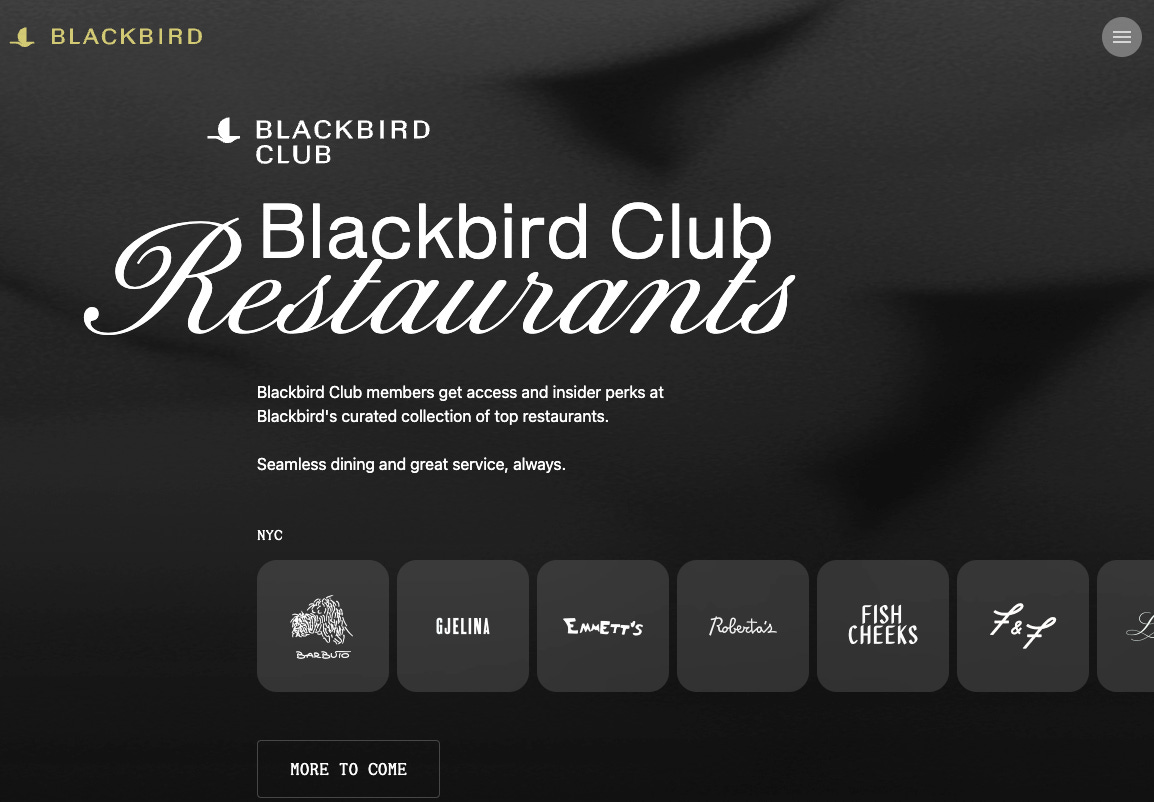
The loyalty and payments play from Resy founder Ben Leventhal, now CEO of Blackbird, is (finally) rolling out its promise of cross-restaurant loyalty and access. Blackbird Club, launched today, promises “a more satisfying thank you” to its members at partner restaurants like La Tête d’Or in New York and SPQR in San Francisco. Members get perks including priority access to reservations and other special events, plus guaranteed reservations at a small handful of restaurants. And as part of this initiative, Blackbird is offering specific and useful rewards to restaurant workers, a constituency that Leventhal says has traditionally been left out of the equation.
Blackbird entices its users to patronize restaurants — to show up, as they say — with $FLY, an in-house cryptocurrency that works a lot like credit card or airline points. Diners earn $FLY by tapping their phone on a puck to “check in” at certain spots, or by paying through the app. For the last six months or so, employees at Blackbird partner restaurants could earn $FLY by showing up at work and tapping in on an employee-specific, purple puck. Leventhal says that Blackbird has distributed more than 95 million $FLY to the restaurant industry, ostensibly keeping those funds inside the network.
For diners, membership in Blackbird’s club requires… a commitment. They commit either time — the lowest tier requires 25 restaurant check-ins at Blackbird’s restaurants; the highest, 50 or more — or money, depositing at least $5,000 worth of $FLY to be spent at its partner restaurants.
Blackbird Club Pro, the employees-only version that will launch in a few months, gives industry workers extra points for checking in at Blackbird restaurants, plus 20% off dining and five times the points for dining out on Monday and Tuesday — typically “industry night,” whether announced or unspoken — at participating spots. It’s a highly specific and intentional focus.
“We have to figure out what what matters the most and how to make sure that this group [of restaurant employees] is properly treated and compensated,” Leventhal told me in a recent interview. “I think rewards specifically for the industry are going to matter a ton.”
Blackbird, which has taken $85 million from tech-forward investors including a16z and Coinbase, wants to help us recapture a particular type of restaurant energy. Leventhal calls this “the magic of hospitality,” a phrase that, admittedly, reads a little precious. That so-called magic is a know-it-when-you-feel-it thing that’s proved historically tricky to capture with an app. But I get it.
Take, for example, the way that New Yorkers (and former New Yorkers) of a certain age responded last week when restaurateur Andrew Tarlow announced his category-defining Brooklyn restaurant, Marlow & Sons, would close. Social media (and our email inboxes) filled with remembrances and reminiscing and feelings about late nights or lazy afternoons at the bar; about drinking too much and eating too little; about finding a just-right restaurant within stumbling distance of home. “Have you checked on your elder millennials this week?” asked New York Magazine’s chief critic, Matthew Schneier in a Marlow eulogy of sorts. Clearly, plenty of us understand “the magic of hospitality.”
That’s the vibe that Blackbird’s chasing, in a handful of cities to start. It’s live in about 600 US restaurants, with a couple hundred more signed on, a comparatively small effort considering the 20,000 or so restaurants now listed on Resy, Leventhal’s previous company. But it’s a high-profile effort given its founder’s track record of helping to modernize restaurants, even if it sounds complicated to the uninitiated. (Blackbird maintains an extensive FAQ.) Similar to the idea of hospitality magic, restaurant people — the type willing to tap their phone on a puck for points and/or commit $5k to future spending — can sniff out a commitment to the cause.
I caught up with Leventhal ahead of today’s launch, where he further explained his motivations for the industry carve-out and also how his thinking about serving restaurants with good tech has evolved since the earliest days of Resy.
Our conversation has been lightly edited for length and clarity.
Expedite: Blackbird is a consumer app, but there’s this largely unseen industry side. Why target restaurant employees specifically?
Ben Leventhal, founder and CEO, Blackbird: “We’ve realized when we talk about the restaurant economy, there’s actually three constituencies. There’s the restaurants, largely represented by restaurateurs and operators and owners. There’s guests. And then there’s the third constituency, which is restaurant industry workers. Grouping restaurants and restaurant workers together has historically been a mistake. They often have divergent interests and aren’t naturally aligned when it comes to incentives, except that both parties want the restaurant to be full and both want consumers to spend as much money as they can. As we think about the restaurant economy of the future, economic independence for restaurants, and the importance of reasserting some control for the industry and ownership of data, we are of the view that restaurant workers have to be recognized and properly calibrated for to make the system work as best it can.”
Is this a response to worker requests? Or a perceived need?
“Probably a little bit of both. When we started Resy, we said Resy was ‘by restaurants, for restaurants.’ Now, whether explicitly or implicitly, a lot of companies use that construct to explain how they’re building toward the future. But the thing I’ve realized that’s missing from that — by restaurants, for restaurants… it wasn’t really with restaurants. That’s the key difference with Blackbird, it’s more of a true partnership.
“This question of whether it’s a need for workers — it’s a little bit of where we think things are going. But it’s just the right way to think about this business, as a collaboration. Just because the operators are happy doesn’t mean that we’ve solved for the people that are working the restaurant. We think that by giving restaurant workers rewards and keeping them engaged, we can ensure that money stays in the network. Restaurant workers are also restaurant consumers and a lot of this is about engaging and retaining those individuals.”
What’s the vibe in restaurants in New York right now?
“A couple weeks ago, New York Magazine ran an interesting essay about whether or not anything changed in the industry after Covid. I posted a response to it. It’s fair to say that structurally restaurants are more or less the same. But I think operators have a new savviness and are doing things differently. They’re more in control of their own destiny.”
Last time we spoke, I asked you what you were excited about for the future of restaurants and you said something that stuck with me, that restaurants understand the power of their own brands much, much better than they have previously.
“Ten years ago, the playbook was to open as many doors as possible as fast as possible. Now, it’s about slower, more deliberate expansion. Successful operators go less out-of-pocket to open new locations. They don’t have to raise as much equity when they have, for example, real estate development partners. I think that’s all positive.
“Still, some restaurants are working and others aren’t. At the end of the day, restaurants fail because they don’t find product-market fit or because they have an owner that doesn’t know how to read a P&L — or both. That’s pretty fundamental, and I don’t think that’s going to change.”
I ask you this question every time we talk, and I’ll ask again: Are restaurant operators finally excited about good technology?
“There is no question restaurant operators are as open to new things as I’ve ever seen them be. I think they’re excited about tech, excited about innovation. They want to see progress and want to see things change. A decade ago, there was a real hesitance to embrace new things and largely now there’s an eagerness to embrace new technology. The limiting factor is, obviously, operations have to continue to be smooth. The conversations we’re having now are about an excitement for change and figuring out what implementation looks like.”
