


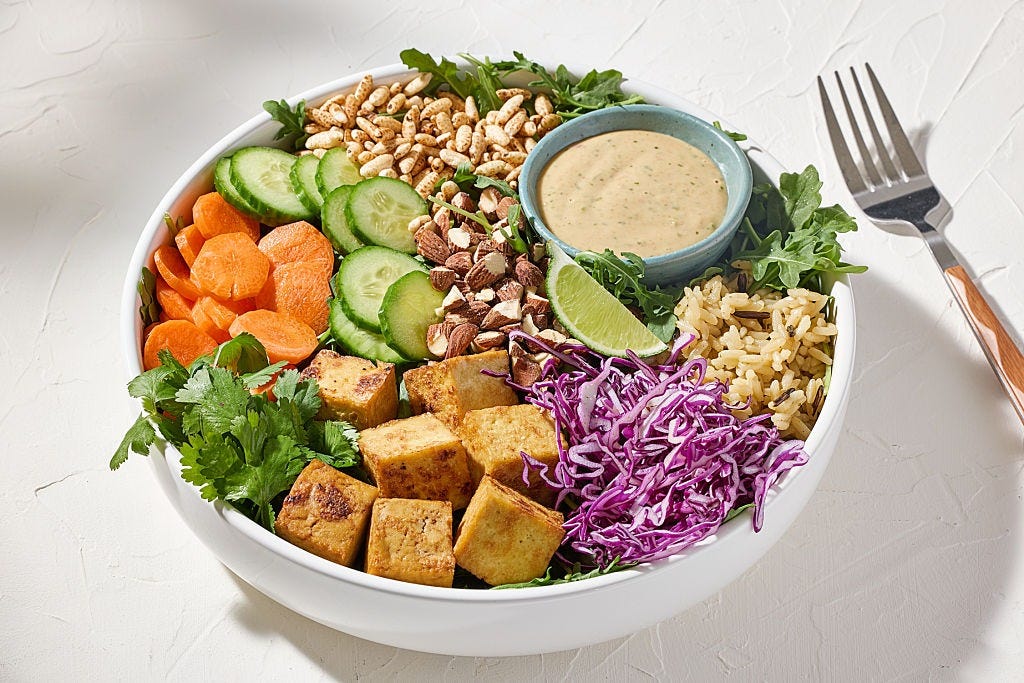
Earlier this week, Merriam-Webster (the dictionary) shared its word of the year: slop.
The dictionary defines it as digital content of low quality that is produced usually in quantity by means of artificial intelligence — all of the drivel that’s clogging our social feeds and online searches. (I’ve also heard this called “botsplaining,” a portmanteau I particularly enjoy.)
The AI-adjacent word also made its way into restaurants this year; the slop bowl is a term, born of social media slang, used to describe menu items from chains like Sweetgreen and Cava and Chipotle, constructed from many ingredients and served in a bowl.
Slop bowls were discussed at length earlier this year, largely thanks to a New York Times column titled, “living the slop life.” The bowls were just one facet of the story, which also used the word slop to describe fast fashion and a certain kind of digital videos. (ugh, Cocomelon, IYKYK.)
In the case of the slop bowl, constructed at speed inside modern fast-casual restaurants and often bagged to go, “the selling point of the assembly line is efficiency, not craft,” the Times says.
I’m neutral on slop bowl. I find it to be a convenient if controversial catch-all that captures this particular moment in restaurant culture and experience. (This is probably why other journalists use it, too.) It conveys a little edge, a little shade, a little commodification — at a time when the onetime glow of the halo around fast-casual restaurants like Sweetgreen is dimming. (As of early December, Sweetgreen, Cava, and Chipotle had lost a combined $48 billion in market value in 2025.)
I called on some experts to ask for their takes. “Is the term fair? I asked them. “Will it stick? Should we be calling these bowls something else?”
Some declined to comment, including a rep for Wonder, the New York-based convenience restaurant concept that spent $186 million to buy bowl-building robotics tech from Sweetgreen a month ago. At the time of the acquisition announcement, Wonder’s founder, serial entrepreneur Marc Lore, lauded the tech’s ability to work across “any cuisine and price point.”
Others, including an exec from Cava, didn’t respond to my request. (No hard feelings.)
But here’s what some experts who did respond had to say. Most of these quotes have been very lightly edited for clarity, and emphasis is mine.
Nicolas Jammet, co-founder and chief concept officer at Sweetgreen, over email:
“Trends may come and go, but our approach to making food at Sweetgreen has been the same from day one. We’ll leave ‘slop’ to the dictionary, not the menu board. What we provide is the opposite of anonymous or industrial. Our menu is built around real cooking, done by hand, every day, in every restaurant. Nearly everything on our menu is made in-house from scratch, from preparing our produce in the restaurant to our roasted vegetables, grains, and proteins. We intentionally work with farmers and growers we know by name, many of whom we’ve partnered with for years. We prioritize organic sourcing whenever possible — in 2025, roughly 70% of our produce suppliers are either organic, IPM or using transitional growing practices — and we focus on ingredients grown responsibly, in season, and with transparency around where they come from and how they’re produced.”
Jonathan Neman, co-founder and CEO at Sweetgreen, in a quote I lifted from a LinkedIn comment:
“At SG we make almost everything we serve from scratch in our stores daily. We source thoughtfully with partners we know and trust. We balance taste, health, price in every chef creation. I view the term as derogatory and actually lazy slop from those that are hurling it. ”
Grace Snelling, editorial assistant at Fast Company covering all things Gen Z (and slop bowl), on the phone:
“The restaurants think it’s a pejorative term — or at least they don’t want people to be using it — because it has an element of inherent disgustingness. The way that young people are using it on the internet is sort of in the middle. It’s not a cute term… it’s definitely poking fun at office culture, and that’s the most common context you’ll see this in: ‘People on the corporate treadmill leaving their cubicle for an hour to go get their slop bowl.’ Most people are in on the joke, and they’re not saying they hate the food. If brands embraced it in this way, I think the internet would be on their side.”
Lauren Fernandez, industry investor, general partner, founder and CEO, Full Course, via phone:
“As in any sort of marketing cycle, when you reach ubiquitous status it starts to become denigrated. It’s so normalized that now we’re making fun of it. Delivery has a lot to do with this; the format of ‘make a bowl as you go across a line’ works for a high level of customization and interaction, but it doesn’t guarantee a beautiful product will arrive to you via delivery. I’d suggest its application to fast-casual-as-a-price-point is consistent with Gen Z’s pushback on fast casual dining this year — it’s part of their very vocal commentary on value.”
Ryan Sutton, New York City-based restaurant critic and author of The Lo Times, who does not identify as a “bowl-eating person,” over email:
“My off-the-cuff response is that it wouldn’t be the worst thing in the world to come up with a nicer term than slop, which has a variety of tough connotations outside of AI. But then again maybe my own concept of niceness doesn’t matter much here because it appears as if The Discourse has already issued its verdict by fiat in this regard, and that these are indeed Slop Bowls (so harsh!). I am intrigued by the implications of these conversations, which is that these fast casual spots — which purport to be on or near the ‘top shelf’ of the fast food space — now have a hugely negative designation attached to a product that costs like $13 to $19 or whatever and that previously carried quite a bit of cultural cachet.”
Brandon Barton, CEO of touch-screen ordering company Bite, my friend and v. opinionated podcast co-host, via text message:
“‘Slop bowl’ is lazy and trite. Feels like any brand that is doing bowls can become a victim of this lack of descriptive effort, which means it’s applied unfairly. Yet, I have seen some slop bowls in 2025. Some made by people, others made by robots. So they exist. And I don’t think we’ll be using the term deep into 2026. It’s fun to say right now, especially because “AI Slop” has entered the vernacular (thanks Sora!) but I think it won’t (and shouldn’t) last as a descriptor of some brand’s hard work.”
Hillary Dixler Canavan, journalist and founder of What Are We Having? a recipe-forward newsletter that wants to make dinner easier, on Substack Notes:
“Honestly I find it very accurate.”
Me: “Because of ingredients or presentation or process or… all of this?”
“All. Also the rhythm and sound of the giant serving spoons plunking various mushy components on top of each other. It’s slop-like.”
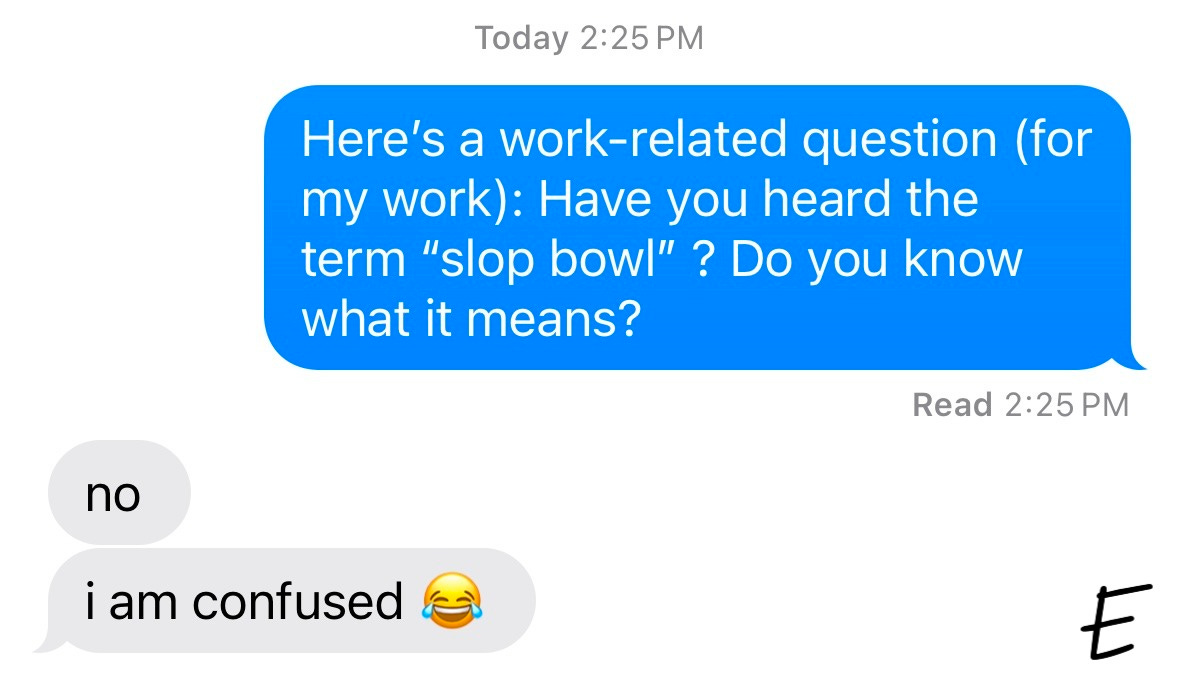
My 17-year-old niece Adriana, who’s active on TikTok but has never visited a Sweetgreen, over text message:
Related content:



I loved this. Made me laugh. Made me think. IMHM(millennial)O that no one asked for, Cava gives 'slop' but sweetgreen does not. I think Nic + co have been on average really consistent -- like any company there's been swings, hits (collabs, sourcing), misses (robots), but to me their ingredients have been consistently delicious. I dont live in a sg market and often try to recreate the Shroomami at home. If that's defined as slop, whatever, it's craveable as hell.