
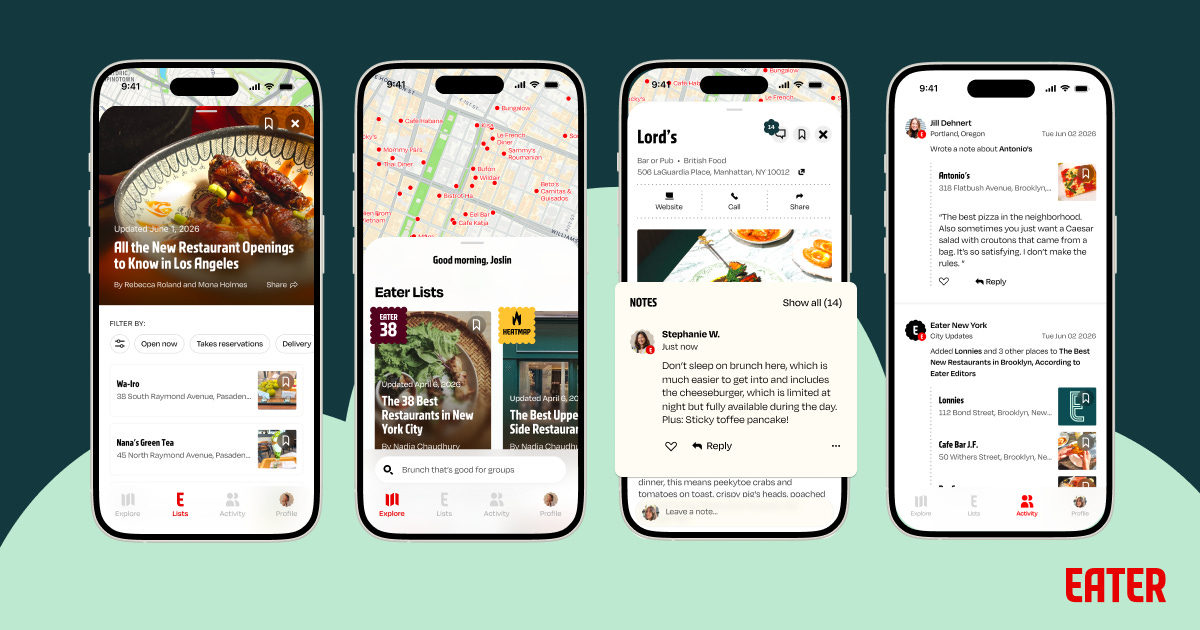
Today’s edition of Expedite is unlocked, courtesy of Eater.
Finding the right restaurant is both a science and an art. Recent tech advances have the science on lock; there’s no shortage of service and apps and sites and social media accounts vying for attention with promises of perfect and personalized restaurant suggestions for any occasion. The art is much, much trickier. Even in an age of unprecedented technological progress, it requires a distinctly human touch.
The way we discover restaurants has quickly and dramatically evolved. Take generative artificial intelligence — AI that can talk to you — for example. It’s considered the fastest-adopted technology… ever. And while plenty of us are using it, we’re all still learning how to live with it.
In a 2025 global study from the University of Melbourne, well over half (66 percent) of respondents used AI tools regularly, but fewer than half (46 percent) said they don’t yet trust it. More recently, in an annual report published in April, the Stanford Institute for Human-Centered AI determined that artificial intelligence is advancing faster than our ability to both understand and trust it. The companies behind major models like Claude and ChatGPT release a near constant drip of updates, and tech that wows today could be obsolete in a matter of months.
That sounds scary. (It is kind of scary.) We can’t stop the inevitable march of technological progress, but we can lean into the things that make us feel most human.
I was thinking about this tension when the team at Eater, the 20-year-old restaurant news publication, told me they’d launched a new mobile app earlier this year. A new app? Now? But then I talked to Stephanie Wu, Eater’s editor-in-chief, about the reasoning behind launching something new — now — and also the evolution of restaurant search, discovery, and recommendations in an age of artificial intelligence.
“On the Eater team, we talk frequently about the fact that robots can’t go to a restaurant, experience the service, soak in the atmosphere, or taste the food,” she said. “Dining is a deeply human experience — not just the act of eating but also the community that’s built when dining with others.”
Our conversation continues below. Like all Expedite Q&As, it has been lightly edited for length and clarity.
Expedite: Do you think restaurants have a good understanding of how their diners find them?
Steph Wu, Eater: “Owning a restaurant has never been an easy task, and I think it’s only become more difficult as the discovery landscape has shifted so rapidly. A diner might come across a restaurant on TikTok, check its rating on Yelp or read about it on Reddit, book through Resy, and then post on Instagram. This is extremely hard to track, particularly for first-time visitors, and especially when independent operators are making so many other decisions simultaneously, from POS and reservation platforms to investing in PR agencies, managing deliveries and pickup orders, and everything else that has to work within their famously thin margins.
“While we cover the news and identify what’s new and exciting in markets across the country, we’re also a powerful record of what’s good and worth it, including restaurants that have been around for decades. Our work has undeniable impact.”
Do you have any concerns about the way restaurant discovery is evolving? Or how quickly it’s evolving? I’m thinking, specifically, about influencers and about AI.
SW: “In our ongoing user research around dining discovery, it’s common to hear distrust around the larger influencer landscape. It’s hard to tell when a recommendation is genuine if a meal has been paid for by the restaurant. And more and more, we’re hearing restaurants share more openly when they’ve been approached by influencers that are demanding payment on top of a free meal in exchange for a post. That’s absolutely not to belittle the restaurants who do invest in these lower-lift marketing tactics, particularly in smaller markets or when they can’t afford a full PR agency. But from a diner’s perspective, it’s become harder and harder to spot genuine recommendations, and at a time where the costs of dining out have gone up immensely, people want to ensure they’re finding a great meal every time.
“The AI question is certainly something we’re watching closely in the long term. When someone asks an AI agent where to eat in a new city, the response is likely pulled from a multitude of sources, and then flattened to create a generic recommendation that’s meant to appeal to as many types of diners as possible. Eater will always be a brand run by extremely opinionated humans who love restaurants, and I don’t see the value of that going away anytime soon.“
Eater just launched a new mobile app. How does it fit into the restaurant discovery and recommendation landscape?
SW: “Historically, Eater on the web has been focused on discovery and inspiration and helping you understand the wider world of restaurants and restaurant culture. This app is first and foremost as a utility. It is a place where you can take all the incredible work we’ve done — spread out across all the ways that the internet works — and hone in on: ‘I need a place to eat. Tell me where to go.’
“The number-one strength of this app, obviously, is that it is built on our editorial content. We update our editorial content every single day, maps publishing every single day. That is like the crux of what you’re going to find in the app. The content comes directly from our editorial team. It’s the work that we’ve done for two decades. Our editors are dining out all the time, more frequently than I can even wrap my head around.”
I grew up with Eater; we launched, professionally, around the same time. That makes it a legacy brand in the restaurant industry. How do you keep it relevant?
SW: “We recognize that Eater is a brand that is really meaningful to an audience that’s been following us for a really long time — maybe not all 20 years — but certainly there’s the brand and the association. At the same time, we very much recognize there’s much more of a shift toward wanting to know individual Eater editors and their voices. We are not this broad, nameless entity. That shift is nothing new, it’s been a thing for publications to put their editors and staff front-facing for some time.
“But most of all, I believe the biggest value of Eater is that our audience cares deeply about food and dining out, and will very gladly share with others when they’ve found a restaurant they love. They’re loyal to great places, and that makes our audience hugely valuable to any restaurant owner. After all, it’s the regulars that ensure restaurants stay in business in the long term.”
Eater’s new app featuring curated recommendations, expert suggestions, and social connectivity — basically a trusted, digital friend with great intel — is available to download in the app store.
Thanks again to my friends at Eater for sponsoring this edition of Expedite.