

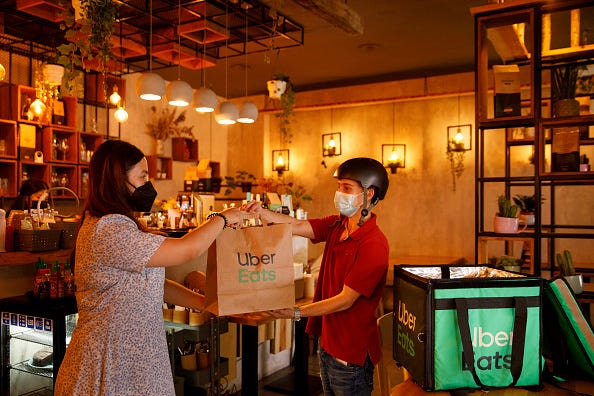
Another week, another story about lawsuits and regulations in third-party delivery. The courts continue to slowly poke at the industry’s business model as a flurry of laws, regulations, and lawsuits make their way through the system. As a whole, the efforts to regulate the big business of third-party delivery by targeting individual — but vital — parts of their businesses. But will anything actually change?
Last week, a federal judge refused to throw out a class action lawsuit targeting Grubhub, Uber Eats, and Postmates. (The suit was filed in April 2020, months ahead of Uber’s Postmates acquisition.) The suit alleges that diners — even those not using delivery apps — faced higher prices at restaurants because of the commissions and fees food delivery companies charge restaurants. Here’s the logic: according to the filing, restaurants facing so-called exorbitant fees from food delivery companies can’t offer customers lower food prices when ordering directly from the restaurant, for take-out or dine-in. It seeks damages for customers who purchased food directly from restaurants that were also listed on big services dating as far back as 2016.
There are others. Separate challenges target permanent commission caps levied by cities and sharing customer data with restaurants.
Plenty of cities levied commission caps at the start of the pandemic, but many fell off the books as restrictions eased. New York is among a handful of cities vowing to keep the caps permanent; the delivery services meanwhile have made good on their executives’ promises to fight the changes in court.
Also last week, the US Chamber of Commerce backed the big delivery services fighting the caps. In a brief, the organization — which is not a government entity but instead the country’s largest lobbying group — said that the caps will harm the same restaurants they purport to protect. The rationale: government-imposed caps will force delivery companies to raise prices for consumers and cut back on services, reducing demand for restaurant delivery on third-party platforms. Andrew Rigie, executive director of the NYC hospitality alliance, said the organization “delivered a horrible message that they support billion dollar 3rd Party Delivery Companies at the expense of struggling independent restaurants in NYC.”
Then there’s the data. New York lawmakers also instituted another set of guardrails on the delivery apps last year, requiring them to share customer information with restaurants. Delivery companies pushed back immediately, and the city agreed not to enforce the regulation as the case plays out in court. This one, like the others, is ongoing.
Experts say the lawsuits aren’t surprising given the new laws and regulations represent exceptionally serious constraints on the apps’ pricing power. One expert I spoke to for a piece last fall called the regulations an existential threat to their business. He also questioned the laws’ ability to stick — it’s rare for the government to impose such strict pricing controls on business, he said.
Delivery companies have also adjusted practices; for example, I’ve heard a once-contractual clause requiring restaurants to maintain pricing across channels — that is, they can’t charge more for food on the apps — is rarely enforced. Plenty of restaurants, including huge ones, like Chipotle, publicly share that third-party delivery economics require them to charge higher prices.
They’ve also expanded. Over the past two years as cities and restaurants and customers have debated the merits of fee caps and limitations on the business, the companies have worked to make themselves indispensable to restaurants and consumers, partnering with more restaurants, branching out into new areas like convenience stores, even opening delivery-only stores and restaurants of their own. They’ve had time to adjust their operations to comply with regulations while growing and growing, and they’ve gotten plenty of face-time with diners who have come to rely on the convenience they offer.
Restaurants have adjusted, too; plenty have found ways to thrive off of the big apps, though more seem to embrace the convenience. The apps themselves have promoted options for direct ordering through their systems that cost restaurants less money. With good data, restaurants can focus on what’s working well on third parties, even if that’s something different than what works in store.
If — and this is pure speculation, I am not a lawyer — the apps win all of their legal challenges and their business is preserved free of caps and limitations, they’ll continue to grow. If they lose some, they’ll still continue to grow, albeit within some sets of guardrails. But as we’ve seen over the past couple of years, there’s plenty of room to expand in all directions; the road we’re on won’t lead to a place devoid of big delivery.
In the immortal words of Regina George (sorta): Get in loser, we’re going for a ride.

Hello from my quarterly QR menu check-in
Speaking of contentious business: It is physically impossible for me to not be pulled into any online discussion about QR code restaurant menus. The online debate always seems the same: person inconvenienced by a digital menu accessed from their phone reminds restaurants that people hate them; giant pile-on ensues.
But there are nuances involved that don't translate to online conversations. Namely, the way QR code menus actually work. There are a few options:
1. A QR code directs you to a PDF or web page displaying a menu for you to read on your phone. (Complaints: “They’re hard to read! They’re clumsy! Paper is better!”)
2. A QR code directs you to an interactive digital menu that feels like online shopping; orders are sent directly to the kitchen and delivered to your table. (Complaints: “It’s impersonal! It’s too casual! We’re being tracked!”)
3. Some mash-up hybrid of the above. (Complaints: “We just want things to be like they were before even if that makes it harder for the restaurant!”)
These are fundamentally different experiences that serve different purposes; one simply cuts down on paper menus, the other streamlines service during a staffing crunch, changes the steps of service, and provides the restaurant with valuable customer data. (The practice even got the tinfoil hat treatment in the Times last summer.)
As a self-anointed QR menu expert, no matter your feelings on the technology, I remind you that it’s always okay to ask for a paper menu. But also, I implore you to learn just the smallest bits about the technology at hand to properly inform your future b**ch sesh. Thank you.

What else is happening?
VDC has a CEO. Virtual Dining Concepts announced DoorDash alum Stephanie Sollers will become the company’s first CEO. VDC is the parent company of the hugely successful MrBeast Burger, the success of which it has looked to replicate. It’s also the parent company of the future TikTok Kitchen, a virtual brand once thought to debut last month. On Wednesday, a rep for the company told me the social media-themed concept is still in development.
Yelp expands its health ratings. The review company partnered with Hazel Analytics, a company that collects publicly available health department data — or in some cases estimates generated from publicly available health department data — to expand its health scores program.
Speedy grocer GoPuff lays off 3 percent of its workforce. In a letter posted by Business Insider, the company’s founders attributed the layoffs, which will affect hundreds of employees, to “a realignment of our workforce to reflect our current priorities.” It went on to state that “GoPuff is no longer a U.S. business that is expanding internationally. We are a global company with businesses in both North America and Europe. Our ultimate aspiration is to operate across thousands of cities on multiple continents, and continue to widen how we satisfy instant needs for our customers.”
-Danielle Hyams
Thanx acquires ZeroStoreFront, a data startup from Grubhub alums. The loyalty and guest engagement platform announced this week its acquisition of the marketing and data insights startup led by Grubhub veterans Collin Wallace and Ashutosh Joshi. The two will join Thanx as vice president of insights and director of engineering, respectively. Terms of the deal were not disclosed.
-DH
Introducing Ghost Financial. A new financing tool for ghost kitchens, led by John Meyer, plans to introduce the “first cash-back credit card for food and beverage inventory.” It will use data and tech to underwrite restaurant expansion loans and credit limits for the card. Meyer started the company after his own experience seeking traditional (read: bank) funding for his ghost kitchen business.
-DH