

During a short trip to freezing New York earlier this week, I visited Stars, a truly perfect wine bar as chronicled by plenty of others on this newsletter platform (Here’s Ryan Sutton and Christine Muhlke and Emily Wilson and both Jon Bonné and Melissa McCart off Substack for good measure.)
Everyone who writes about the East Village hotspot from the team behind the beloved Claud and Penny seems to love it. The low light, the pretty front door, the tiny bar with comfy seats, the knowledgable staff, the 50-page bottle list, the puffed and spiced stars on top of an order of deviled eggs and, wow, that shrimp sandwich.
I am no exception to this rule — I spent a lovely evening alone at the bar, I live for this — and others have eloquently shared most of my feelings and observations.
But as I finished my butterscotch pudding dessert (you’ll want to order this) and stood up to wrap myself in a giant wool coat and scarf, this happened:

I didn’t register the quiet and innocuous statement as a flex, and the diner presumably got what they were looking for; in this case, a great glass of Etna Bianco that I ordered an hour earlier, good job ChatGPT. But was the bot’s recommendation better, more personalized, more appropriate, more believable than the personalized service from any of the three employees working the floor?
Depends who you ask. For example:
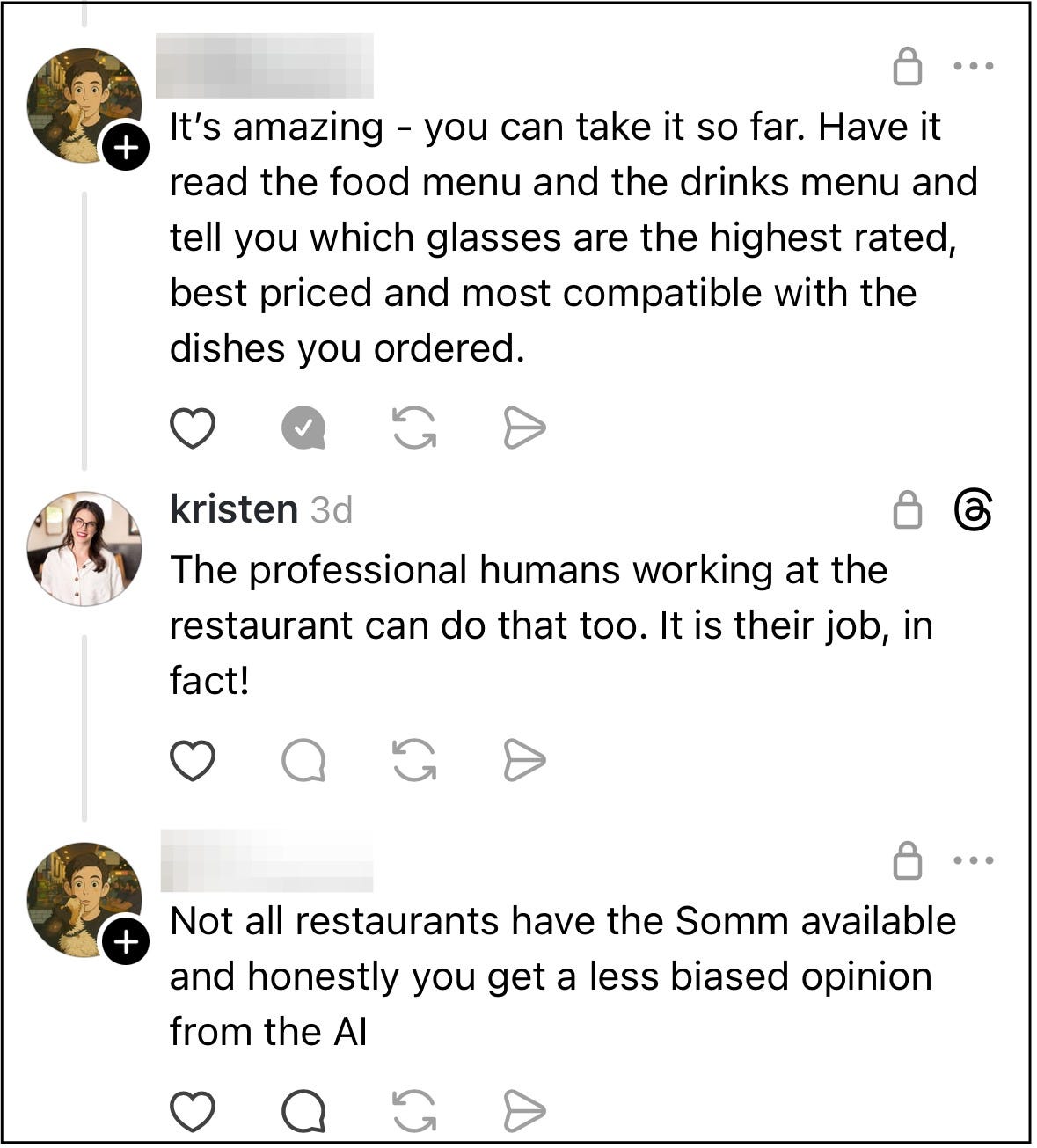
So, uh, what do we think?
Here’s a fun story: A few years ago, French winemakers tapped ChatGPT to make wine with certain grapes from a specific region. “We are a new brand, only five years old,” the owners said. “It’s in our roots to be adventurous and try new things.” The bot offered basic advice, adjusted by a human winemaker to produce the wine IRL. Then, ChatGPT named it poetically: The End.
Wine pros have weighed in on questions about AI in wine and restaurant service for years. It can help a restaurant build a wine list that’ll interest diners, suggesting pricing that maximizes margins. It can help with staff education and training. It might help diners save money, or direct those seeking value.
On the flip side, using AI to choose a wine can hinder the high-touch relationship between restaurant and diner that’s a hallmark of full-service dining. It might remove the art of wine pairing and suggestions, turning it into an exacting science devoid of emotion. It could overlook small, regional, emerging wineries in favor of the large producers that dominate online discourse.
Take any of these pros or cons to the extreme, and we arrive in what feels like a dystopian danger zone: A wine list created only with profit and margin in mind; devaluing human education and specialization in favor of a highly-trained bot, the erasure of wine professionals’ work and criticism, or a digital touch-screen experience foisted on fine-dining tables. And how long until a large language model like ChatGPT just invents a fake wine varietal or producer and sells it as real?
There’s room for nuance here, as always, in matters of technology and hospitality. (A bot helping to navigate a 50-page wine list is helpful in the absence of a high-trained sommelier!)
The irony is that we’ll need to trust humans to get this balance right. So shouldn’t we trust them to choose us the right glass of wine?